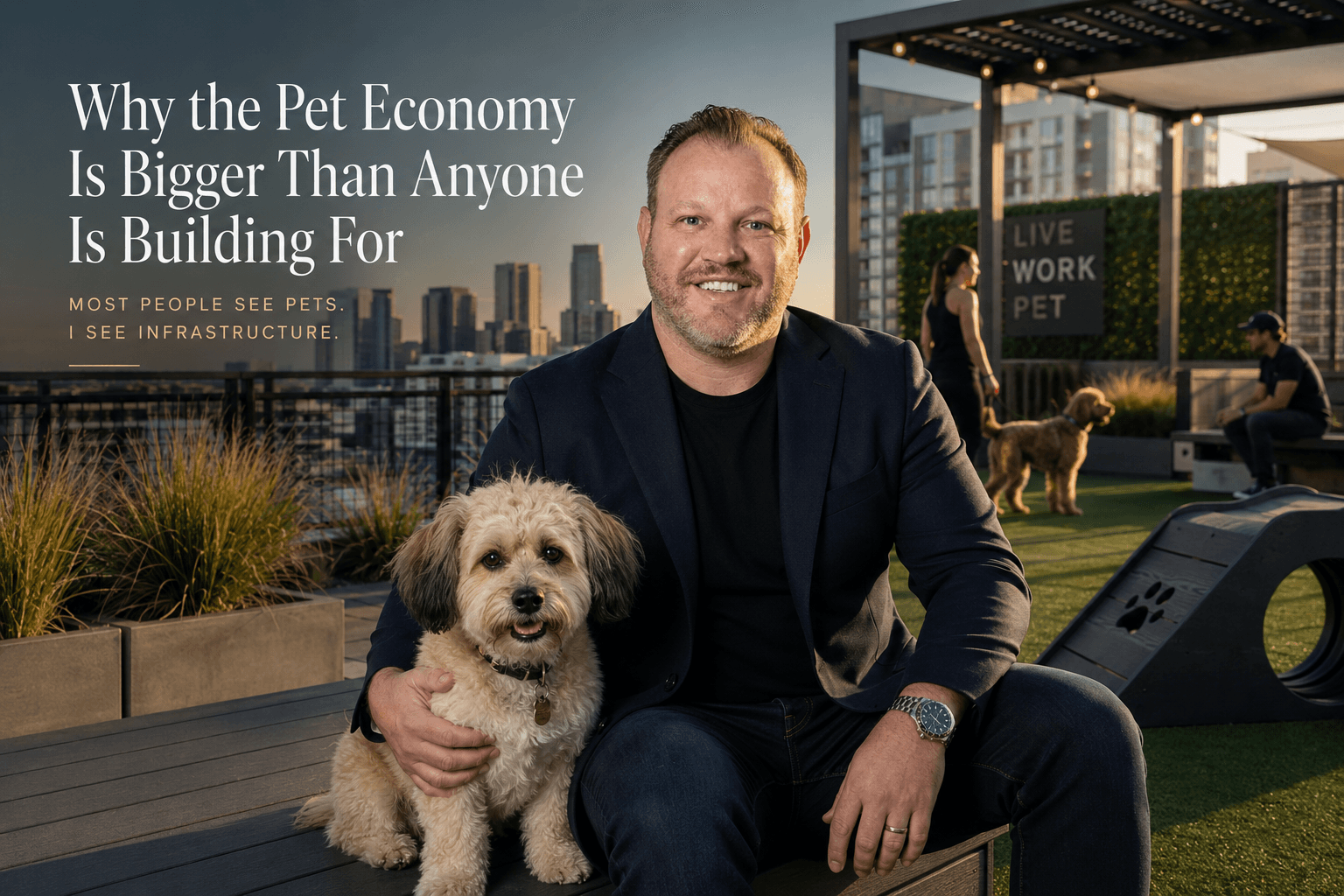
Why the Pet Economy Is Bigger Than Anyone Is Building For
Why the biggest opportunities in pet are no longer in products, but in infrastructure.
Most people still think of the pet economy as a consumer category built around food, toys, treats, and accessories. That framing increasingly misses where the market is actually going. Over the past two decades, the pet industry has quietly evolved into something far larger and more durable: a behavioral economy built around recurring spend, healthcare, services, logistics, housing, and infrastructure.
That distinction matters. Once you stop viewing pets as a consumer vertical and start viewing pet ownership as one of the most durable recurring behaviors in modern life, the opportunity set changes dramatically. You stop looking for the next premium dog treat brand and start looking for the operating systems powering how people live with their pets.
What dog walking taught me about trust
I have spent most of my career in this category. Before co-founding Wag, I built a dog walking business in Los Angeles called SurfDog LA. That business taught me something early that still shapes how I think today: this was never just about dog walking.
From day one, I realized the real product was trust.
Clients were not simply hiring someone to walk their dog. They were trusting me with a member of their family. I treated the service accordingly. I would bring my laptop to every initial meet-and-greet and document everything in detail, from where food was stored to feeding schedules, preferred walking routes, behavioral quirks, medications, and even routines as simple as giving a frozen treat after a walk.
What I learned was powerful. Customers were not looking for just a dog person. They wanted a professional they could trust with a family member.
That insight shaped everything.
I also noticed something else. Pet care was highly fragmented, operationally messy, and surprisingly underserved. Most providers were still operating like traditional local service businesses. Scheduling was manual. Payments were inconsistent. I made it easy for customers to pay via PayPal, Venmo, or credit card, and strongly preferred recurring credit card billing because it reduced friction and created consistency. Even at that early stage, I could see the outlines of a much larger opportunity.
When SurfDog LA started doubling every six months, the opportunity became obvious to me. At the same time, companies like Uber and Airbnb were changing consumer behavior. They were training people to expect trust, convenience, and on-demand access in categories that had historically been fragmented and offline.
I believed pet care was next.
Many people thought the market was too small or too niche. I saw something very different. Pet care had attractive unit economics, low startup costs, and highly recurring demand. More importantly, consumer behavior was shifting. Dogs were no longer just pets. For many people, they were family.
Building Wag: from local service to national marketplace
That insight became the foundation for Wag.
At Wag, where I served as Co-Founder, first CEO, and Chief Dog Officer, we helped transform a highly localized service into a national marketplace. When we launched, most people saw dog walking as a neighborhood service business. I saw recurring behavior, fragmented supply, and a massive trust problem waiting to be solved.
That combination matters.
Recurring behavior creates frequency. Fragmented supply creates opportunity. Trust problems create defensibility.
That is the foundation of great marketplaces.
One surprise after launch was just how quickly demand accelerated. Consumers clearly wanted the product. What caught me off guard was how difficult it was to support that demand operationally at scale. Our early app and customer service infrastructure were nowhere near ready for the velocity of growth.
Growth alone solves nothing
That experience taught me one of the most important lessons of my career.
Growth alone solves nothing.
I think about growth as the head of the business. Operations and technology are the legs. If the head grows too fast but the legs stay small, the business eventually falls over.
I have seen this happen repeatedly across marketplaces.
You cannot scale acquisition without scaling operations and technology to support it. Operations teams often fight in hand-to-hand combat every day, solving customer issues, resolving edge cases, and holding the system together. Technology must be built not just to drive demand, but to support the operational complexity created by growth.
That lesson still shapes how I build today.
Trust and safety at scale
Trust and safety also became central to everything we did. One of the hardest problems early on was home access. We solved that with lockboxes, making it easier and safer for walkers to access homes. But the bigger challenge was always trust at scale.
Most walkers were exceptional. In fact, one of the biggest surprises at Wag was how seriously many walkers took the role. We found incredible people who genuinely cared. Many felt proud to represent Wag and treated the responsibility with real professionalism.
But when things went wrong, they really mattered.
The hardest moments were lost dogs. Those incidents kept me up at night. We built what became a best-in-class lost dog recovery system with rapid-response protocols that activated immediately. Every second mattered. Our teams moved fast, and we achieved very high recovery rates, with the vast majority of dogs returned quickly and very few remaining missing overnight.
Experiences like that reinforced something I believe even more strongly today: the pet economy is fundamentally about trust.
The next era of pet is infrastructure
The U.S. pet industry is expected to reach roughly $158 billion in 2025, but I believe many people still misunderstand where the real opportunity lies. The first era of the pet economy was products. The second era was services. The next era will be infrastructure.
That is where I believe the largest businesses will be built.
Healthcare infrastructure. Insurance rails. Data infrastructure. Property technology. Embedded services.
These are the systems powering pet ownership itself, and most remain deeply underbuilt.
The pet-first real estate opportunity
This is especially true in housing, which I believe is one of the most overlooked opportunities in the entire category.
Most apartment owners still think about pets through a defensive lens. Breed restrictions, weight limits, deposits, and pet rent dominate the conversation. The mindset is centered around minimizing liability.
I believe that lens is wrong.
Pets are not just a policy issue. They are a powerful behavioral signal. Pet owners stay longer, spend more on convenience and services, and increasingly choose where to live based on how well a property supports pet ownership.
That changes the equation.
The real opportunity is not simply allowing pets. The opportunity is building for pet owners in a thoughtful and intentional way.
That is a major reason I am building Live Work Pet.
I believe the next generation of multifamily communities will not simply accommodate pets. They will be designed around modern pet ownership, with embedded services, integrated care, better amenities, stronger community, and infrastructure built specifically for how people live with their pets.
That creates meaningful value for everyone involved. Residents get a better experience. Owners improve retention. Operators unlock new revenue. Communities become stronger.
That opportunity is far larger than most people realize.
What I’m building toward
After spending years in this category, I remain deeply bullish on where this market is headed. I have seen meaningful progress. I have seen innovation, growth, setbacks, and failures. Through all of it, one thing has remained true: the pet economy keeps growing, becoming more sophisticated, and moving closer to the center of how people live.
I genuinely believe I was put on this earth to make a meaningful impact in this industry and to improve the lives of pets and their people.
At Wag, I came up with the tagline, “A dog’s best friend.”
That idea still resonates with me.
That is what I want to build toward.
The biggest companies in the next era of pet will not simply sell products to pet owners. They will build the infrastructure that powers pet ownership itself.
Most people still see pets. I see one of the most important and underbuilt infrastructure opportunities of the next decade.
Building in pet, marketplaces, or real estate?
I enjoy connecting with founders, operators, and investors building meaningful companies at the intersection of consumer behavior, marketplaces, infrastructure, and real estate.